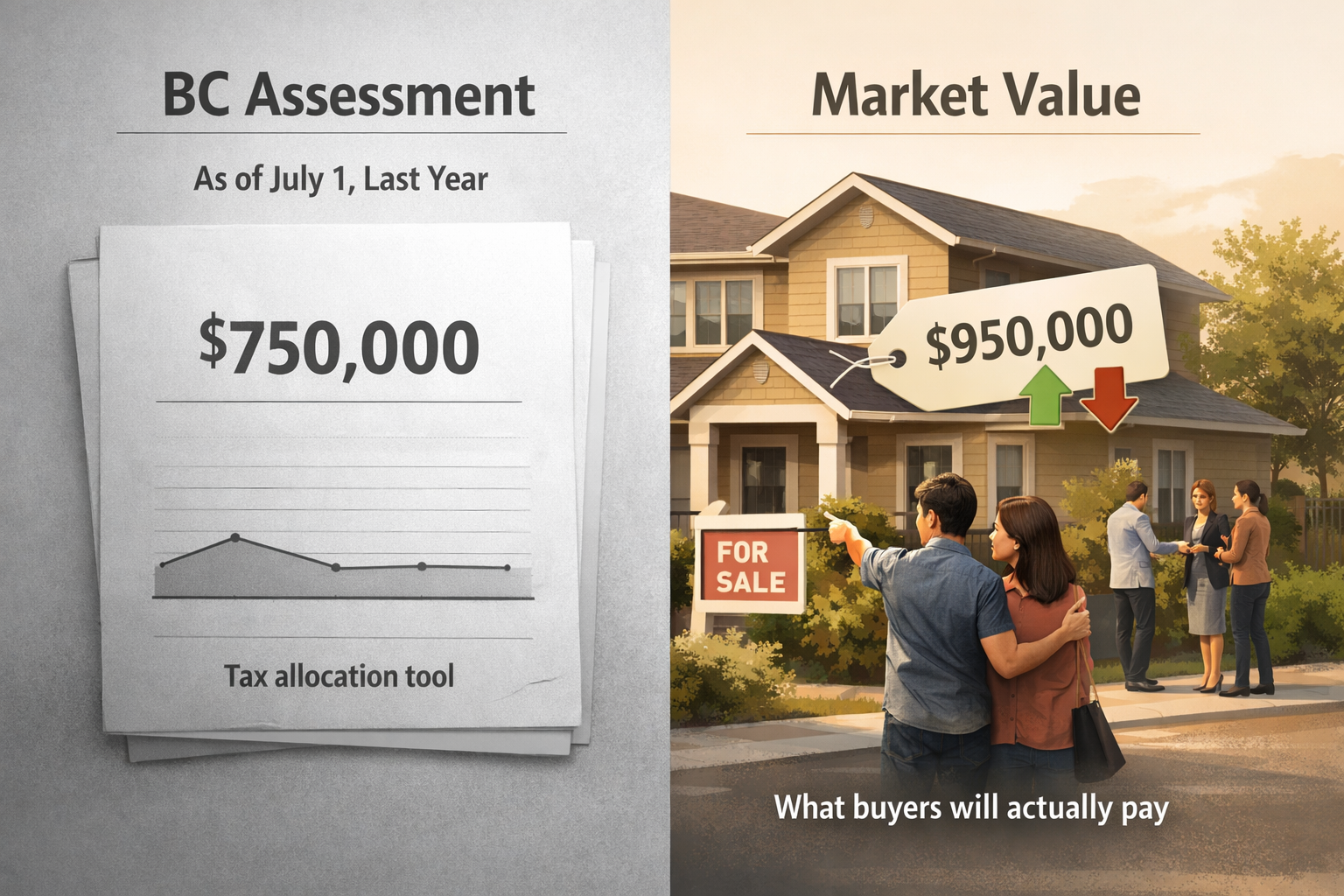
And Why Even Informed Homeowners Still Misread It — Especially When Selling in the Next 3–6 Months
Most homeowners already know one thing about BC Assessment: is not market home value !
What’s less understood — even among experienced owners — is how BC Assessment still influences tax outcomes, pricing psychology, and decision-making errors right before a sale. Those misunderstandings don’t show up on paper. They show up in days on market, price reductions, and lost leverage. It’s a practical clarification of where BC Assessment still matters, where it doesn’t, and how to interpret it correctly if you’re making a real decision in the next 3–6 months contact me.
What BC Assessment Is Actually Designed For
BC Assessment’s core function is property tax allocation — not pricing homes for sale.
It works by:
* Valuing properties as of July 1 of the previous year.
* Comparing each property relative to others in the same municipality
* Helping municipalities distribute the overall tax burden
If My Assessment Went Down, Will My Property Taxes Go Down?
Not necessarily. Property taxes are based on relative change, not absolute value.
* If your value fell less than the municipal average your tax share can increase
* If it fell more than average, your tax share may decrease
* If the city increases its budget, taxes can still rise regardless
This is why assessment headlines often mislead even savvy homeowners.
Why BC Assessment Is a Weak Pricing Tool
BC Assessment does not reflect:
* Current inventory or competition
* Buyer urgency or negotiation behaviour
* Renovation quality or presentation
* Micro-neighbourhood demand shifts
Markets move faster than assessments — especially in transitional or uneven conditions.
A Personal Example: When I Asked BC Assessment to Go Up
After completing a substantial renovation on my own property, I requested BC Assessment increase the assessed value. Not to pay more tax — but because the post-renovation assessment no longer reflected the property accurately relative to comparable homes.
The lesson is important:
* BC Assessment can be corrected when factual changes exist
* Accuracy matters for tax fairness
* But correction still doesn’t turn assessment into market pricing
BC Assessment Property Classes (Quick Reference)
This article focuses on Class 1: Residential but BC Assessment values all property types under different classes — each with distinct tax dynamics. any questions for your business contact me as well. Even residential taxes are influenced by how other classes shift within a municipality.
Class 1 – Residential:Homes, condos, townhomes, duplexes, manufactured homes
Class 2 – Utilities:Rail, pipeline, electrical, telecom infrastructure
Class 3 – Supportive Housing: Designated supportive housing
Class 4 – Major Industry:Mines, mills, large manufacturers
Class 5 – Light Industry: Warehousing, manufacturing, logistics
Class 6 – Business & Other: Retail, offices, hotels
Class 7 – Managed Forest Land: Privately managed forestry land
Class 8 – Recreational / Non-Profit: Parks, places of worship, community halls
Class 9 – Farm:Land actively used for farming
What BC Assessment Is Not Good For
Setting a Listing Price
BC Assessment:
* Uses backward-looking data
* Ignores buyer competition today
* Misses emotional and presentation premiums
Using it to price a home often leads to overpricing or mistimed launches: Predicting What Buyers Will Pay
Buyers negotiate based on:
* Recent comparable sales
* Active competing listings
* Interest rates, confidence, and urgency
They do not negotiate off assessed values.
What Is the Market Value of Your Home?
Market value is simple in definition — complex in practice: Market value is whatever a qualified buyer is willing to pay under current conditions.
It’s driven by:
Current comparable sales
Supply vs. demand in your segment
Location, condition, layout, and presentation
Buyer sentiment at that moment in time
Unlike BC Assessment, market value is real-time. that is why Professional Appraisals Still Matter A licensed appraisal provides an independent, data-driven estimate of value and is often required to:
Sell with realistic expectations
Buy with protection against overpaying
Refinance or insure a property
Appraisals support decisions — but even they don’t replace strategic pricing and timing. Treat BC Assessment as background information only. Before acting on it, ask:
* How does my assessment compare to nearby homes right now?
* What inventory am I competing with today?
* Are buyers negotiating — or bidding?
Those answers don’t come from an assessment notice.
Bottom Line
BC Assessment does an important job — tax fairness.
It was never designed to:
* Price homes accurately
* Predict buyer behaviour
* Guide selling strategy
If you’re planning to sell or downsize in the next 3–6 months, understanding the difference between assessment, appraisal, and market value gives you clarity — and leverage — before you act. please fill out the form below for custom and private discussion.
.
